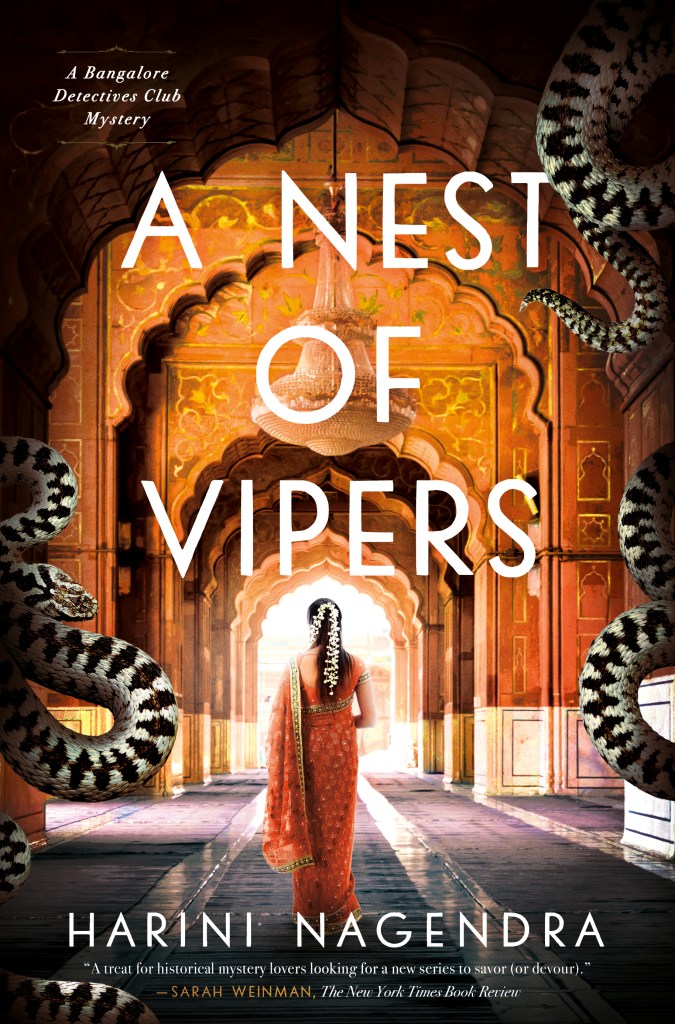
I loved a recent conversation I had with Harini Nagendra on the SinC Writers’ Podcast, and was delighted when she agreed to come back to the blog to celebrate her latest release, A Nest of Vipers. Welcome Harini!
Making your voice heard
Thank you Julie, for hosting me on Wicked Authors – and thank you to all the Wicked writers and readers for joining this conversation! I’m thrilled to be back again, speaking about my 1920s historical mystery series, set in 1920s colonial India – The Bangalore Detectives Club.
The first book, The Bangalore Detectives Club, features 19-year-old Kaveri Murthy, a new bride who has just moved to Bangalore to live with her doctor husband Rama Murthy, and her troublesome mother-in-law Bhargavi. Young and feisty, Kaveri loves mathematics, and wants to study further, but there are few opportunities for women to enter college and take up mathematics or science at the time. She swims in a sari at her favourite club, and learns how to drive her husband’s beloved Ford – but frets about wasting her time and intelligence in purely domestic pursuits.
When she stumbles across a dead body at dinner in an influential local club, her new career as an amateur detective takes off. Kaveri sleuths in her elegant saris, criss-crossing the bungalows, brothels and cowherd quarters of Bangalore as she searches for clues to the murderer. In book 2, Murder Under A Red Moon, Kaveri is pulled into investigating an embezzlement – but ends up investigating the murder of a wealthy industrialist Sharma – in the backdrop of growing calls for Indian independence.
Book 3, A Nest of Vipers, opens in January 1922, at the time of the visit of Edward, Prince of Wales to India. When Edward visits Bombay and Calcutta towards the end of 1921, he is greeted by widespread protests, riots, and calls for the British to quit India. The British respond by packing the jails with Indian protestors, while violence continues to ratchet up. According to sanitized newspaper accounts, Edward’s visit to Bangalore was relatively peaceful – but that seemed unlikely. It got me thinking – what if there was a plot to derail the Prince’s visit to Bangalore with riots and explosions?
I also wove in other themes. I have always wanted to write a book about Indian jadoo, street magic, which was co-opted by many western magicians such as Harry Houdini and exploited outside India, while dismissed within the country as acts carried out by charlatans and tricksters. A Nest of Vipers begins therefore with a circus performance, a few days before the Prince’s visit to Bangalore. A famous Indian magician performs an act that veers dangerously close to what the British would term sedition – and then vanishes from stage. His son approaches Kaveri for help – but her friend Inspector Ismail turns strangely hostile, warning her to stay away. This book takes Kaveri into territories that are far more dangerous than she has encountered before. And it gave me an opportunity to explore the debates around choosing violent vs peaceful approaches to protest against the British Raj, which were especially intense in the early 1920s with Mahatma Gandhi calling for non-violence.
Readers, there may be many issues that each of us would like to raise attention to – whether climate change, issues of race and gender, or anything else. I choose writing as my way to call attention to environmental issues that are closest to my heart, but I have many friends and colleagues whose work I deeply admire, who take to the streets, use social media and move the courts – using non-violent, peaceful means.
What issues do you feel most strongly about, and how do you choose to make your views known? Do you think the path of violence could ever be justified for a larger goal? I don’t, but I’d love to hear your views on the topic.
One US hardcover copy of A Nest of Vipers will be given away to a commenter, selected at random. To enter, leave a comment – any comment, it could be as simple as a ‘hello’ . This giveaway is only applicable to readers living in the USA.
About A Nest of Vipers
Death stalks the streets of Bangalore when the Circus comes to town . . .
January 1922.
The Bangalore Constabulary is on high alert as The Prince of Wales is scheduled to visit the city to redeem his reputation after disastrous visits marked by violent anti-British riots.
Kaveri has none of these concerns on her mind, not when she has just been given VIP tickets to the famous Bangalore circus. But when a celebrity magician, shackled in an iron cage filled with deadly snakes, disappears into thin air, she is stunned to discover her friend and favourite policeman, Inspector Ismail, is telling her to leave the case well alone.
After solving two murder cases, Kaveri Murthy thought she had cemented her reputation as Bangalore’s favourite lady detective. But when death threats are left at her doorstep, former friends become foes, and the bodies start to pile up, Kaveri realises she has never been in this much danger . . .
About the author:

Harini Nagendra is a professor of ecology at Azim Premji University, who features in Stanford University’s list of the top 2% cited scientists in the world. The Bangalore Detectives Club, her first fiction book, is in the New York Times list of Best Books since 2022 – and is followed by two sequels, Murder Under A red Moon, and A Nest of Vipers. She has also written a number of non-fiction books – most recently, Shades of Blue: Connecting the Drops in India’s Cities. Harini lives in Bangalore with her family, in a home filled with maps. She loves trees, mysteries, and traditional recipes.
More about the book, including links to purchase, at my website – A Nest of Vipers – Harini Nagendra

 The Wickeds
I don’t think violence is the answer to anything.
LikeLike
I agree!
LikeLike
Welcome back, Harini! You have picked such a fascinating time to write about. And it’s awesome you have activist friends who use peaceful means – that’s the only way to do it.
LikeLike
Thanks Edith. My environmentalist friends do such a terrific – and important – job.
LikeLike
Personally, I think peaceful means far out way those that take a more drastic and often times harmful way to voice their opinions. We love critters – all critters. Knowing that many are endangered purely because of man’s encroachment upon the place they call home, has us using our love of photography to show not only their beauty, but how they are a vital part of life as we know on this planet earth. Whether it be the honey bee, which drastically effects our lives with their decline, to the grizzly bear, they all have a place and a purpose. Man needs to learn to respect that fact before it’s too late. Hopefully, the images that we capture and the information we share with them, will open at least a few eyes making a sort of domino effect for change.
Congratulations on the recent release of A NEST OF VIPERS. It sounds amazing! I would love the opportunity to read and review it. I’ve added it already to my TBR list and can’t wait to dive in reading it.
2clowns at arkansas dot net
LikeLike
Kay, I couldn’t agree more – we need to respect and make place for all creatures with whom we share our planet! Thanks for your interest in A Nest of Vipers
LikeLike
i agree that violence isn’t the answer
LikeLike
That’s great!
LikeLike
Absolutely no violence, too much in this world already. I choose to support causes I’m interested in, animals and the environment, by doing donations.
LikeLike
Kathy, yes indeed, we have way too much violence in the world already. There are so many ways to contribute – yours is a very important role to take up
LikeLike
A Nest of Vipers sounds captivating and intriguing. The era and the history interest me greatly. Violence is not the answer ever. I donate time for worthy causes especially dog rescue.
LikeLike
Sharon, if you like the time period, I hope you enjoy the series too. In book 2, Kaveri rescues the “ugliest dog” (there was an actual prize with this name, which inspired this bit of the story) and brings him home – he’s an integral part of A Nest of Vipers too. Animal rescuers do such an important and difficult task
LikeLike
Thanks for visiting, Harini! I absolutely love historical mysteries and will have to check yours out. I live with depression, so I often address mental health issues in my books. We’ve come a long way to smashing that stigma, but there’s still a long way to go.
LikeLike
Thanks for writing in and sharing this – we do have a long way to go, and what better way to get people to think about mental health issues than through fiction! I enjoy historical fiction too, which is why I started this series, and I hope you enjoy reading the books
LikeLike
Welcome back! A Nest of Vipers sounds amazing!
LikeLike
Thank you Sherry! I hope you like the book!
LikeLike
Congratulations on A Nest of Vipers. The locale, and background are fascinating and learning about real history is important and of great value. Violence never achieves the end result. Unfortunately we see too much of it. It is important to support good and vital causes.
LikeLike
Thanks Anne. I enjoyed the research for the book, and in particular, the debates around why non violence was a critical element of the Indian independence struggle. There are many important lessons to take away from this period in time
LikeLike
History shows violence is never a solution. I feel that tolerance of differences of any sort would make it a much more peaceful world. Along with small signs on my car, it is the way I live my life.
This series sounds fascinating and I would love to win this book. I would happily then buy the first two books!
LikeLike
Ginny, the sign on your car sounds very interesting. I completely agree that we need more tolerance and to take the effort to understand each other a little better, especially in today’s divided world. Thank you for your interest in A Nest of Vipers!
LikeLike
Welcome to the Wickeds, Harini. What a fascinating time and place to write about. I’m also not a fan of violence but I’m keenly aware of the role wars, including the Revolutionary War and the Civil War played in the history of our own country. As well as the ability of protests to move public opinion, including in the the Civil Rights era and in ending the War in Vietnam. I think crime novels are often able to comment on current events and history in a way that in other forms would seem preachy. I often write about class and economic inequality but it is a background in my work, not the main story, and very much organic to my setting in coastal Maine, though a part of life for us all.
LikeLike
Barbara, I have learnt so much about different times and places from mysteries too! Your books in coastal Maine sound very interesting
LikeLike
Interesting questions. I do not believe violence is the answer, but I do believe in the right to make your voice heard by peaceful means. Writers are practitioners of the pen, and there is much truth to the adage that it is mightier than the sword.
On a day to day level, I have long said that I vote with my buck. If a business espouses something I do not believe in, or it they have a tradition of wrongly treating people, my dollar, as small as it is, will not be contributing to their cause. Is it effective, probably not, but it’s a peaceful solution.
LikeLike
Kait, vote with your purse, I completely agree! There are so many ways to make our opinions felt, and we should use all the leverage we can, from writing to deciding where we take our business
LikeLike
First of all, let me say how much I love this series. I look forward to reading A Nest of Vipers. We have so much violence around us. I prefer writing about issues and often incorporate them in my novels.
LikeLike
Thanks so much for your support, Marilyn, I hope you enjoy A Nest of Vipers too! I find writing a very cathartic way to speak about issues close to my heart too, especially when they resonate with readers
LikeLike
Welcome back Harini! Congratulations on the birth of A NEST OF VIPERS. I love everything India in every way. I have traveled extensively throughout your Amazing India, and I thinbk Bangalore is especially captivating. Your books are fascinating and so cleverly written. I dispise violence, as it does not solve anything in the end. I dream of one day having world peace, where we all hold hands, loving each other…but I am a dreamer, which is why I read so I can go to a writer’s FUN-tastic worlds and befriend their characters. Thank you for your wonderful writing and vivid locations and characters who are very much aline! Luis at ole dot travel
LikeLike
Luis, it’s wonderful to know you have travelled across India and enjoyed the other books on the series. I hope you like this one too. Thank you for writing in!
LikeLike
I don’t think violence is an answer to anything. Your book sounds amazing. I like the India setting. Looking forward to reading the book.
LikeLike
Thank you Dianne – I agree, I think we have too much violence in the world as it is. I hope you enjoy the book, and a glimpse into pre-independent India when these issues were being debated
LikeLike
The path of violence is never the way to go. Civil disobedience is what the people in America and some ancestors have used to make their points. We all should have learned that throughout the years. These protestors today are so out of knowledge that it hurts my head. They don’t know Geography, History, common Sense, evil, and so many other things that I learned as I grew up. They just want a cause to make them feel that they are somebody, and they are infiltrated by people that want to use violence for their own agenda. I have always been interested in India since colonial times. This series sounds wonderful. I would love to win this book.
LikeLike
By the by, I as a retired English teacher, taught my students about civil disobedience from “Antigone” to the Boston Tea Party and on to Martin Luther King’s “Letter from a Birmingham Jail.” That is the way to solve issues. But in today’s world, there are too many instigators and money behind them and too many liberals indoctrinating our youth. God bless us all. I love the 1920s. I am a collector of silent movie star memorabilia. India has always been an exotic place in many of these movies.
LikeLike
Civil disobedience can be such a powerful tool, and how wonderful that you could teach it to your students. Yes, sadly India has been exoticized for far too long, and I hope that, as an Indian writing about my country, I can provide a more realistic and complex view. When we try and simplify too much, we lose important nuance.
LikeLike
Hello. I think we each do what we can. For me, it is supporting others as we pray for peace and defending the blue bird nestlings from the blacksnake who would love to snack on them.
LikeLike
Barbara, that’s a lovely way to contribute! Thanks for writing in
LikeLike
I really enjoyed the first two books in this series, and look forward to A Nest of Vipers.
LikeLike
That’s terrific, I’m so pleased to hear this and I hope you enjoy A Nest of Vipers!
LikeLike
Peaceful protests are more powerful than violence. Ghandi taught this lesson with such power.
I care deeply about the rights of the disabled. They have the right to be treated with respect and dignity.
LikeLike
Gandhi’s lessons were powerful indeed, and have so much resonance for the world’s challenges today! Rights of the disabled are very close to my heart too because of family experiences, at least in India things have improved substantially over the past two or three decades but we still have a long way to go
LikeLike
I’ve been enjoying Sujata Massey’s series set in 1920’s India, your series sounds very interesting with a different angle to see rhe same events – like the visit by the Prince of Wales! I do agree with you about the importance of nonviolent protest.
LikeLike
I love Sujata Massey’s books too! I hope you enjoy this view into a different part of India through A Nest of Vipers
LikeLike
Wow! I love the cover!!! This book sounds so good. Love stories on India.
LikeLike