Sherry here in sweltering Northern Virginia — we did have three fabulous low-humidity days. Such a joy to open the windows this time of year!
I’m editing a few chapters for an unpublished writer and it made me think about how much wonderful writing advice we’ve shared during our eleven years of blogging. I think the first bit of writing advice that really stuck with me was from author and college professor John Dufresne. It was, as the title of this blog indicates, “Sit your ass in the chair.” In other words, write.
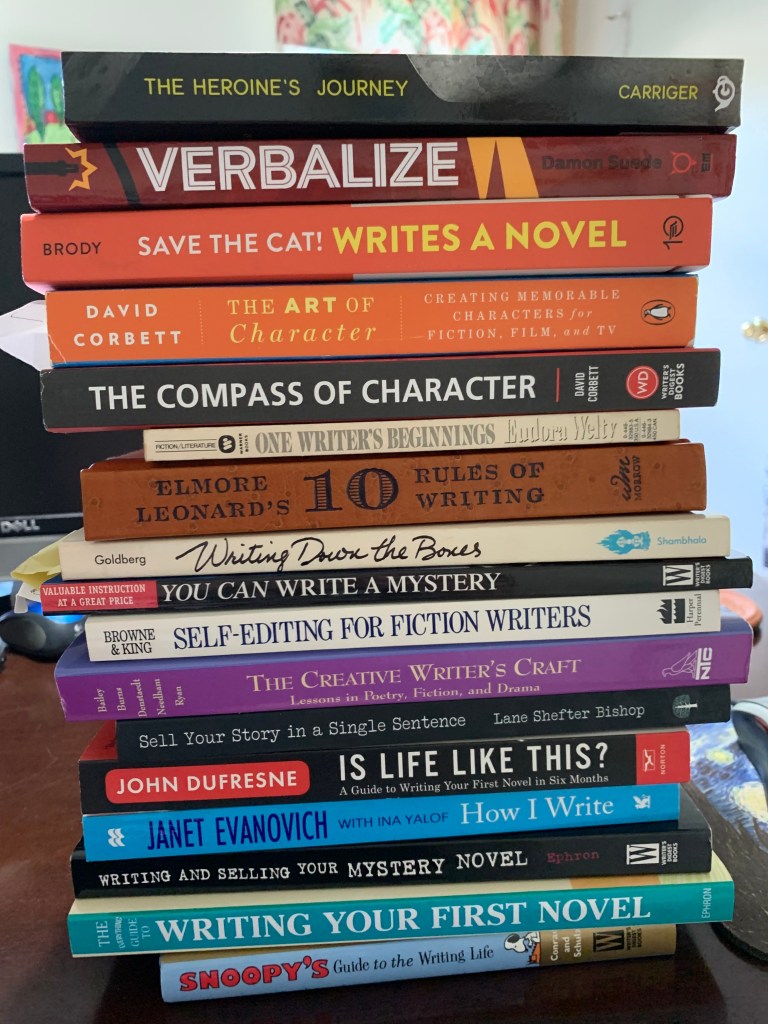
This is just a few of my writing books! There are more on my iPad. Jessie recommended The Heroine’s Journey to me and it is very interesting!
John Dufresne joined us in 2013 to talk about opening a book and that advice still stands. Read it here. He also wrote one of my favorite writing books The Lie That Tells a Truth: A Guide to Writing Fiction.
A mentor to all the Wickeds, Hallie Ephron, wrote about enjoying the mess when writing. She says: My sage advice is: Do whatever works for you. Another favorite book on writing is Hallie’s Writing and Selling Your Mystery Novel Revised and Expanded Edition: The Complete Guide to Mystery, Suspense, and Crime.
in 2016 we all talked about writing advice we’d received. Read it here.
Annette Dashofy offered this advice about writing through tough times in 2018: Find a time of day that works for you, whether it’s before dawn, during your lunch break, afternoon, or late at night, and make a ritual of writing. It might be one hour. It might be 20 minutes. Let your family know this is your sacred time to “go to Las Vegas.”
Be flexible. Stuff will happen. You may have to change your routine depending on life’s demands.
Allow yourself to write crap. If your brain isn’t into the story, that’s okay. Put down words with the knowledge and intention that you’ll fix them later. Sometimes the simple act of getting words on a page can prove cathartic.
Above all else, be kind to yourself. Ask for a deadline extension if things are that dire. Don’t add to the stress by beating yourself up about needing to write when you simply can’t. Remind yourself that everything is fodder. You might be going through hell, but you can draw from those emotions later. Instead of writing fiction, journal. Blog. Or pour your heart out in some form that no one else will ever read.
Art Taylor stopped by to talk about writing every day (do you have to?) and sticking with one project. Read it here.
After Jessie finished her fifth novel she wrote about some things she’d learned along the way about writing. Read it here.
There is much more — way too much for one post including Barb’s recent post on voice. If you want to search our posts you can do it by hitting the three little dots on the upper right-hand side of your screen.
Writers: What’s your best bit of writing advice? Do you have a favorite book about writing? Readers: What would you tell a writer? Is there something you love or hate in books?


Thanks for pulling all that together, Sherry! Absolutely – butt in the chair, fingers on the keyboard. Also – find your tribe, your fellow writers in whatever genre you write in. Network, take classes, learn from them, and lift them up. They will lift you up, too.
LikeLike
Exactly, Edith! We’ve all been so lucky to find our people!
LikeLike
Keep writing your stories.
LikeLike
That is so true, Dru Ann!
LikeLike
Reading the earlier posts, I see that some of the Wickeds got some great early advice from wise teachers such as Hallie Ephron and Hank Phillippi Ryan!
Find trusted beta-reader(s), form a support network and don’t give up!
LikeLike
We were so lucky to have met such amazing writers early in our careers. Trusted beta readers are important too! Thanks for mentioning that!
LikeLike
Think my advice, just as it is, would be to keep doing what you’re doing. A story has to be the author’s first, just waiting to get out, before it can become a story the reading wants to read. You can listen to advice and ways to enhance a story, but “your” story can’t be railroaded by others. From a reader’s perspective, I love it when it doesn’t pop out at you, but you realize eventually that “Hey this author really did their research!” because the details, big and small, are so real that they make the story 100% believable. So in general, keep it up would be my suggestion.
2clowns at arkansas dot net
LikeLike
Great thoughts! Getting hammered over the head with research can ruin a story.
LikeLike
Understand that with the first draft you’re just making the clay. You can mold it into something great during the editing process. I have lots of great books, but am currently rereading The Subversive Copy Editor. A great one! THANK YOU for all of this great information!!
LikeLike
I haven’t heard of The Subversive Copy Editor. Thanks for the suggestion! And I agree with the first draft!
LikeLike
One of my favorite pieces of advice, from Hallie Ephron: Hold your nose and write.
LikeLike
She has the best advice!
LikeLike
While I write my music reviews for albums and concerts plus the book reviews for Mystery Scene (and the ones I put up on Goodreads), I don’t believe that qualifies me to have the cojones to offer any advice. Hell, I barely listen to myself when writing. Pretty much I’m either writing a book review which gets me a nominal fee or the music pieces on an imaginary deadline I set for myself.
When I used to try and write stories, they were legendary for how crappy they were. So I know all about writing garbage. The only time I don’t think I wrote total crap was when I used to invent stories to for my niece when she was young. Every time I sent her a gift stuffed animal, I would send a story to go along with it. And I would interconnect them so the Easter gift would reference the St. Patrick’s Day letter and so forth. Mostly I invented my own characters for the letters, but I did shamelessly rip off a couple of media properties. But I had Vinnie the Valentine’s Substitute for Valentine’s Day, King Brien of the Leprechauns for St. Patrick’s Day and Penelope, the ruler of the Land of Peppermint Reindeer for a Christmas gift. And Ted E. Bear when I sent her a stuffed bear. I even had elves who stole cookies from Mrs. Claus’ kitchen. But since my audience was someone who was less than 9 years old, I don’t think I’m bound for literary glory with those stories.
As for what I would tell a writer regarding what I don’t like it a book. A decades long love triangle amidst a book series that becomes at least 50% cut and paste as the numbers grew ever larger. RESOLVE THE F’N THING!
What I like? I like when a series feels like you are catching up with characters who feel almost real enough that you could imagine hanging out with them. Or at least having breakfast and lunch at their restaurant or bar or buying a book at their bookstore. I want to feel that connection each time I open a new book in the series.
LikeLike
I LOVE that you wrote stories to go along with stuffed animals and connected to other gifts. That is marketing genius that some company should do.
LikeLike
My favorite is: “Butt in chair, fingers on keys.” I may be writing crap, but I can fix that later! My favorite writing book – so many -it depends on where I am in my journey on that day. A consistent one isn’t really a writing book – Stephen King’s ON WRITING. There’s a lot of life advice in there, and it always gives me energy.
Write well, all, and happy weekend ahead.
LikeLike
It’s a great book!
LikeLike
I always love this advice. I need to be reminded (sometimes daily!) that it takes butt in the chair. I have written five novels (five!) but none have made it to publishing. Yet. I keep trying and writing, hoping one will stick like spaghetti on the wall. About once a year, I reread Stephen King’s On Writing. It never gets old and each time through I learn something new.
LikeLike
I have three and a half unpublished novels. I hope you get published soon! And I also have On Writing, but loaned to someone.
LikeLike
Entertain me. Give me characters I want to spend time with. Do that, and I’m yours.
LikeLike
I agree, Mark!
LikeLike
Amen!
LikeLike
It’s hard to top Mark’s advice above, and that’s enough to make a good novel. But ideally, beyond entertainment and appealing characters, I’d like to a) learn something and b) be confronted with a character facing a moral dilemma.
LikeLike
I love those two additions, Kim!
LikeLike
Great advice, Sherry! One tip I’ll add: if you write on a computer, like most of us do, the minute you sit your a@@ down in the chair, open the file you’re working on. Let’s face it, we all get distracted by everything else online. But knowing that file is open and waiting for you is an awesome motivational tool.
LikeLike
That is an excellent suggestion, Ellen. For a while I wrote on a computer that isn’t connected to the internet just to keep me on track. I think I was more productive then.
LikeLike
This spoke to me like that whisper, shout, and then a hammer-thing! I needed this today. Thank you.
LikeLike
You are welcome. I love it when I come across something that inspires me!
LikeLike
I hate when most of the characters’ names start with the same letter!! It gets very confusing when you are just starting a series!!
LikeLike
Oh, I agree! I read one recently that had so many same letter names. It wasn’t fun and took away from what a good book it is!
LikeLike