News Flash: Kim Hays and Beth Schmeltzer are the lucky winners of the Murder Uncorked audiobook!
Edith/Maddie here, away from home in the wilds (not really) of Maine with family.
When I was also away from home last August at Bouchercon in San Diego, a woman came up to me after my panel. She introduced herself and said she was the audio narrator for Murder Uncorked, my first Cece Barton mystery, which was due to release in a couple of months.

I was SO excited to meet her! I’d never met or even corresponded with any of my other audio narrators. We met up again later in the convention and had a chat. After that, we communicated via email about a few pronunciations of names and dialect details for several characters in the book.
When I realized this spring I would be wrangling the Wickeds’ guest spots this month, I asked if Linda would join us to answer questions about her field. I was delighted she said yes! Read down for a cool giveaway.
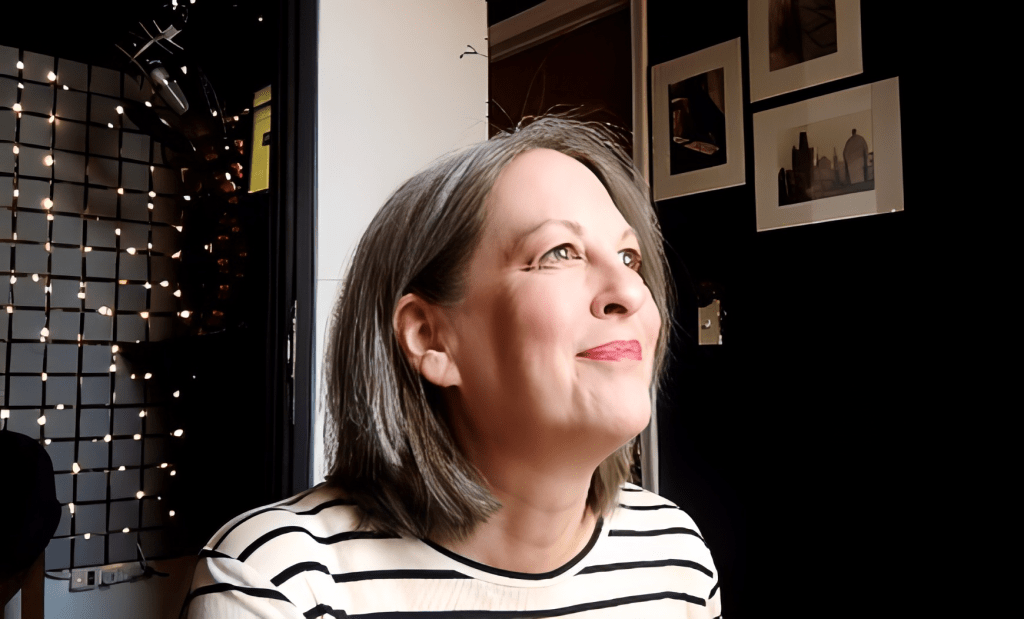
Area of Expertise
I’m an actor working primarily in audiobook narration. I’m also an acting, voice and dialect coach.
How did you get started in this business?
My acting career has grown and shifted over more than 30 years, and arriving at audiobook narration feels very much like the ultimate refinement. It is, for me, the most pure, intimate and intense acting work I can imagine. (More on that below.) I was nine when I decided to be an actor. I’d just played Scrooge in the school play. I was also a voracious reader and shared a love of mysteries and literature—du Maurier, Hitchcock, Edgar Allen Poe—with my mom.
I started college in the Musical Theatre program, but quickly realized that my true love was acting. I earned a BFA in Acting from Ithaca College and headed first to Chicago, then San Francisco and finally New York. I worked in a wide variety of projects in theatre, as well as a bit of film and tv. But I found a real home in new plays and development—I loved working with writers. I did some voice over work, and with my voice coaching and dialect background found a job coaching with Edge Studio in NYC. They cast me in my first audiobook—a multicast, in studio with a director. It was a dream. Books, authors and acting all in one job! I was smitten.
What are three things we should know about your area of expertise?
Well, first: Narrating an audiobook is one of the most wonderfully challenging and rewarding acting jobs imaginable. In a play or a movie, you have not only the words of the script, but also sets and backgrounds, props, lights and sound, perhaps music, other actors to play off of. Your face and body are visible to the audience. In an audiobook, it’s just the actor and the text. The author’s world is transported on just one voice. It’s an enormous responsibility. But it’s also the purest, most distilled acting work there is.
Second: People are often surprised by how much goes into narrating an audiobook. Audiobook narrators wear an enormous number of hats! Every project starts with prep—reading the book not only for plot and characters, but also to get a sense of the author’s voice and cadence, tone and pace. We need to be aware of any surprises, as well as particular challenges like accents we may need to bone up on or specific character traits to consider (for example twins—how to distinguish twins talking in a scene together). We’ll research terminology and pronunciation in both fiction and non-fiction (I’ve had word lists of up to 400+ words).
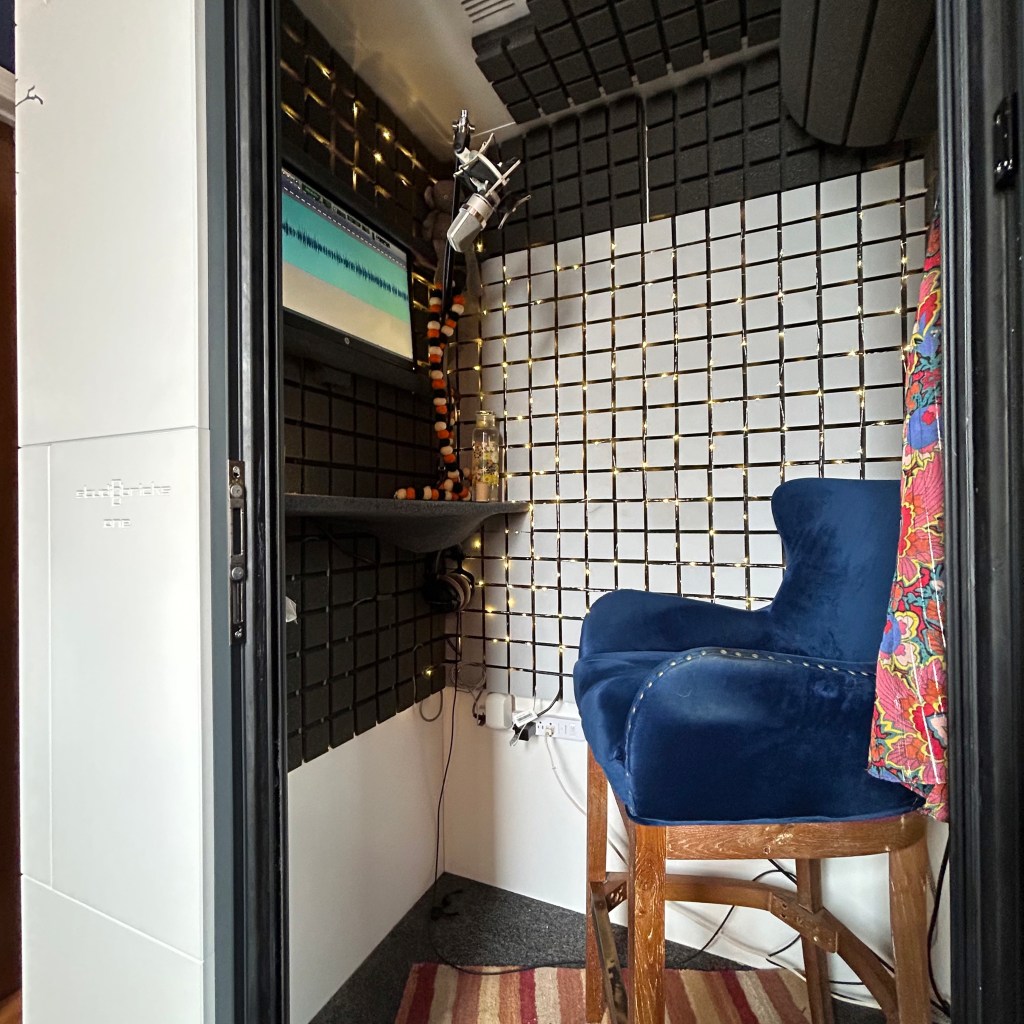
Then we head into the booth. It takes on average about two hours of recording time for every hour of finished audio, so a 10 hour book will take about 20 hours of recording time in the booth. In addition to the acting work, each session requires us to be tech savvy with an array of hardware and software, as well as hyper-aware of our recording space and our bodies.

That booth time is exacting. The mic picks up everything, so we warm up, we wear soft, silent clothes and no jewelry, movement is minimal (the mouth has to stay in the same relationship to the mic throughout), and with no a/c (the mic will pick up the sound) it gets hot quickly. We learn early on what foods we can eat and what to stay away from to keep mouth and tummy noise to a minimum. And we drink copious amounts of tea and water. At the end of a long recording day, my voice and especially my articulators, are tired.
Edith/Maddie: Do you read from a finished book or from a sheaf of paper – which could get noisy? How big is your sound booth (it’s at home, right?)?
Linda: Excellent questions! I read from a pdf of the finished manuscript on my iPad, using a program called iAnnotate to mark it up as needed. Paper does indeed make too much noise.
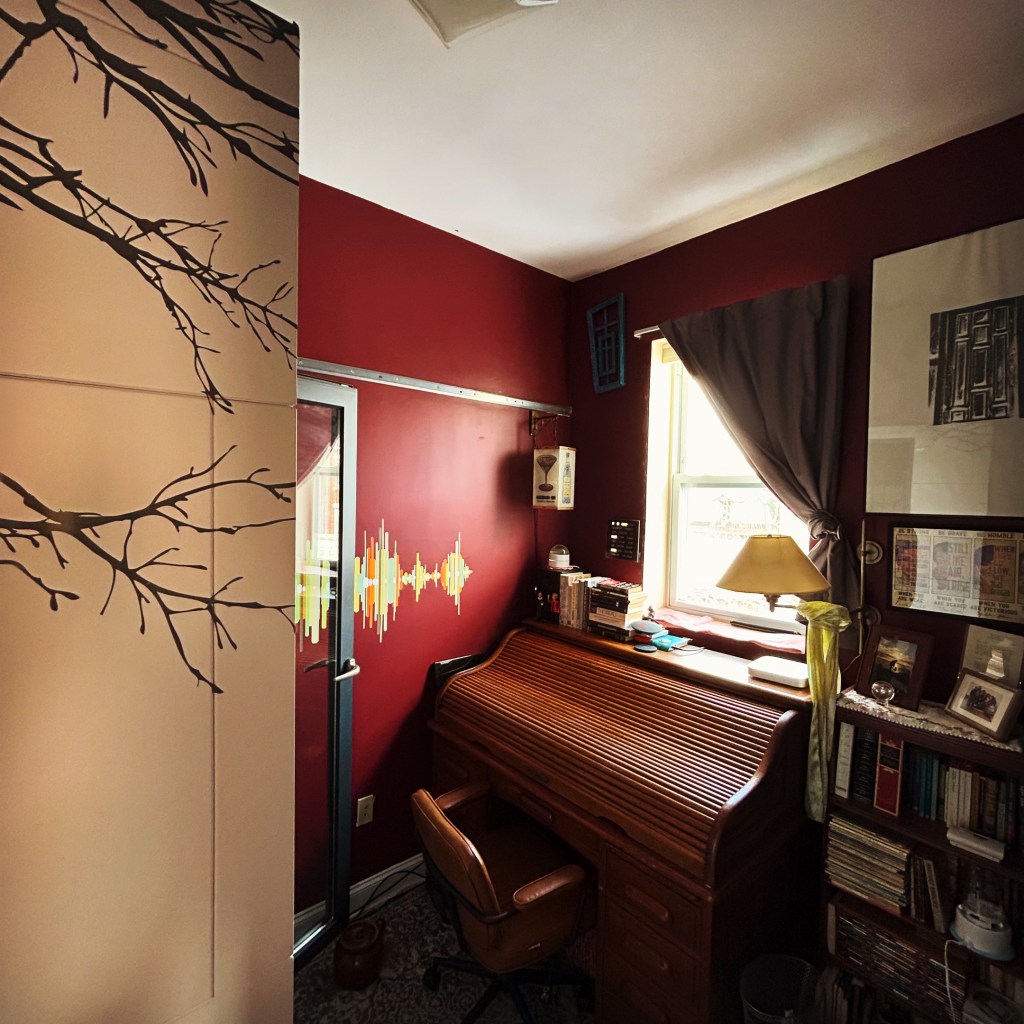
And yes, my booth is in my home. I have a small office that is just big enough for my desk (my great-grandfather’s rolltop), a bookcase and my booth: a Studiobricks, which is a popular and very effective brand of sound booth. Inside, it’s about 3 feet by 4 feet. It’s cozy!
Depending on the material, I can usually record 1.5-3 finished hours in a day. Once that initial raw recording is done, we send the files off to a team of proofers and engineers About 2-4 weeks later, we get pickups—any errors that weren’t caught during the initial recording (misreads, mispronunciations, errant tummy noises, etc.), and we record and upload the corrections.
And third: We’re not actually replaceable with AI. The relationship between author and reader is as human as it gets. Books offer connection, they help us understand ourselves and the world around us. My job is to read your book first as a reader and then to be your voice for the listener, serving almost as a translator into audio. AI doesn’t experience or understand your book. It doesn’t see character arcs or changes in tone, it doesn’t get the jokes or asides. And it can’t communicate what it doesn’t understand. There is no emotional connection, no nuance, no levels, no depth, no sense of pacing or structure, no real understanding of character or of how the story is told. It can recite words off a page, and reasonably well at that. But without fundamental comprehension, it strips the humanity out of the book. It can’t make sense of it for the listener. Humans will always do humanity best.
Is there a general characteristic that experts in this field all share?
We love books and authors! (Heck, I married one.) We’re avid readers and most of us always have been. We love books, talking about books, sharing favorite books and authors. And we’re a gregarious and welcoming community, happy to field any questions authors may have. If we don’t have the answer, we probably know someone who will.
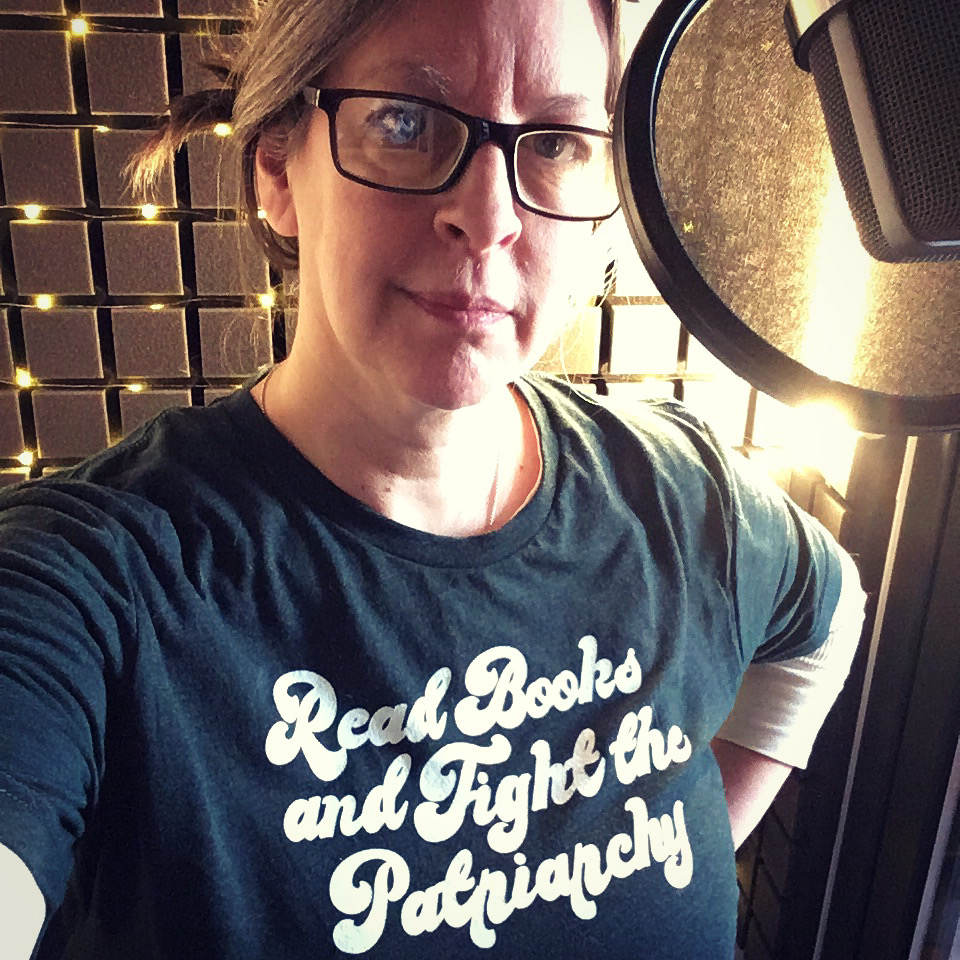
What do people usually get wrong when writing about your field?
“It’s just reading!” There are some that think we just pick up a book for the first time, sit down with a tape recorder at the kitchen table, and read aloud from start to finish. Alongside that misconception, there are misleading youtube videos and “tutorials” hawking narration as an easy side hustle that’ll bring in “big” money. Done right, narration should sound effortless. Really, I should almost disappear so that you forget I’m there and get lost in the story. But as in so many art forms, simple is hard. There is a lot of craft that goes into effortlessness.
Is there a great idea you’d love to share?
I love talking books and audiobooks with authors, and I know other narrators feel the same. I think conferences and meetups that bring us all together can strengthen those relationships and help us understand each other’s work.
What are you working on now?
Well, coming up in the fall I’m very much looking forward to narrating the second in the Cece Barton Mystery series, Deadly Crush by Maddie Day! In the meantime, I’m excited to be part of a Penguin Random House multi-cast for Lucy Undying: A Dracula Novel by Kiersten White, and I’ve got a fabulous (as yet unannounced) thriller on deck. I also recently recorded my third work from Henry David Thoreau, A Week on the Concord and Merrimack Rivers—part of a personal, long-term project to bring all of HDT’s work into audio.
Edith/Maddie: I’m delighted Linda will continue to narrate my series. And I can vouch for hard it is to narrate. I told a 3000-word short story of mine (“One Too Many”) for the Ellery Queen Mystery Magazine podcast a few years ago with only three different characters speaking, and I realized I was in way over my head!
Readers: Do you listen to audiobooks or have a favorite narrator? Ask Linda a question! (And if you want to listen to a sample of her reading my book, click the link here.) Two lucky commenters will win a free audiobook of Linda reading Murder Uncorked!

Linda Jones is an award-winning audiobook narrator recording from her home studio in the wilds of Brooklyn, NYC. She is also an award-winning actor, an accomplished coach and ‘Voiceographer,’ with a background in theatre—from Shakespeare and restoration comedy to a host of premieres (NYC, West Coast, US & World). She loves nothing more than to dig into new work by exceptional writers. Still and always a voracious reader, she has narrated over 120 titles for publishers including Penguin Random House, Recorded Books, Audible Studios, Blackstone, Dreamscape, Brilliance and Tantor, as well as a variety of independent authors and publishers. She is a member of SAG-AFTRA, AEA, PANA (The Professional Audiobook Narrators Association) and the APA (Audiobook Publishers Association). She has a BFA in Acting from Ithaca College.
She and her husband, noted horror writer John C. Foster, and their rescue dog Coraline— a Dutch Shepherd/Pitbull mix — live in an apartment filled-to-bursting, floor-to-ceiling, corner-to-absolute-corner with books.

 The Wickeds
Thank you, Edith, for inviting Linda to do this interview, and many thanks, Linda, for the information you’ve given us on making an audiobook (and on yourself!). There’s an audiobook of my first mystery, PESTICIDE, with a man and a woman narrating the two detectives, and the woman does a bad job. Just to give one example, she clearly hadn’t prepared the manuscript, since she’d read sentences in the same voice even when they were followed by “she whispered” or “she murmured.” Thanks to you, Linda, I now have an understanding of what goes into a GOOD reading, and I’m very impressed. I never thought it was easy, but it’s an even more challenging job than I thought it was.
I am a great fan of audiobooks and listen to them whenever I’m walking for exercise, cleaning, cooking, ironing, folding laundry–and more! Right now I’m listening to Mick Herron’s Slough House series, which are brilliantly read by Gerard Doyle, who also reads Adrian McKinty’s wonderful Sean Duffy books (and others.) I’ve also enjoyed novels read by Julia Whelan. Actually, I rarely hear an audiobook I don’t get lost in, so I think my bad reader was an exception. (Of course, I had no say in picking her.)
LikeLike
Hi Kim – thanks for your response! I’m sorry you were disappointed with your own audiobook experience, but delighted with your listening habits – how fun is it to be transported by a good reader!
LikeLike
This is great insight into narration. I don’t listen to audiobook, I’ve tried.
LikeLike
Thanks Dru! Not everyone listens to audiobooks, but I love that it offers another way for readers to find the books they love.
LikeLike
I enjoyed the insights on the creation side of audiobooks! I love listening às it enables me to get chores done while maintaining my favorite pastime. I also feel that good narration adds to the experience of reading through pacing, accents, and other variations between characters. So thanks for narrating books!
LikeLike
I listen while doing chores too, and when I exercise – it really helps. Thanks for being an avid listener!
LikeLike
I listen while doing chores too, and when I exercise – it really helps. Thanks for being an avid listener!
LikeLike
Linda, I love that desk! Having had to read aloud at events, I’m in awe of narrators who can bring life to a whole book.
LikeLike
Thank you – I love it too! It belonged to my great grandfather (I found my great grandmother’s ‘calling card’ from before they were married trapped in the interior behind a drawer). I was so happy to discover the desk would fit into my office.
LikeLike
Thank you, I love it too! It was my great-grandfather’s (I found my great grandmother’s ‘calling card’ from before they were married stuck deep inside behind a drawer.) I was so happy to find that it would fit into my office!
LikeLike
This was so fascinating, Linda! Thanks so much. I loved the details you shared about clothing, food, and how long it takes to read a book. I’ve been lucky enough to email with my narrators, but haven’t ever met them.
LikeLike
Thanks Sherry – with authors and narrators spread over the globe, it’s rare that we get to meet in person. But it’s such a treat when it happens!
LikeLike
Thanks, Linda, for a wonderful glimpse behind the scenes of narration.
LikeLike
Thank you, too, for taking a look and a listen!
LikeLike
Thank you, too, for taking a look and a listen!
LikeLike
Thank you, Edith, for spotlighting a fellow audiobook narrator. Linda and I have met via social media (hello again, Linda!) and I wholeheartedly agree with her well-thought-out and very clear explanation of the audiobook narration process. Listening to audiobooks isn’t for everyone but audiobooks make so many wonderful books accessible to those who do not use their eyes to read. Also, love your work space, Linda!
LikeLike
Hi Anne Marie – thanks for the kind words!
LikeLike
Thank you, Linda, for this marvelous insight into the art of audiobook narration! I am in awe of you and your colleagues in this exacting field. Taxing work, long hours, unflagging creativity! Your idea of conference panels and other events which bring together authors and narrators is a terrific proposal! I’d love to meet Bahni Turpin, who narrates my new mystery!
LikeLike
Oooh Bahni Turpin is a marvelous narrator – I’ll put it on my TBR! I love meeting authors, so I grab every opportunity. Thanks for your kind words!
LikeLike
LINDA: Thanks for visiting and providing details on the process you use to prepare for an audiobook narration.
Audiobooks saved my sanity in 2020 when I had long COVID for 15 months. Prolonged brain fog prevented me from reading more than 2 books/month. Before that, I used to read 5-6 books/week. I listened to about 60 audiobooks that year.
More recently, I listened to 9 audiobooks this month, mostly new authors and narrators.
Series narrators I really enjoy listening to include Gerard Doyle (Mick Herron’s Slough House spy novels and Deborah Crombie’s Kincaid & James police procedurals), Robert Bathurst (Louise Penny’s Three Pines/Chief Inspector Gamache books).
LikeLike
Oh my goodness, I’m so sorry about the long Covid! I hope it has passed. I totally get not being able to focus on reading a print book – I’ve been there. Audiobooks are a wonderful alternative. Also, I’m noting the books you’re listening to and adding them to my (ever growing) TBR!
LikeLike
Thank you so much for this wonderful article! I love audible books and a good narrator will make me decide if I want to continue listening or not. I am always fascinated by the narrators who can change their voice for different characters, especially if there is an accent involved. I love reading how your area is setup for narration of a book and how careful you have to be of any distracting noises!
LikeLike
Thanks Terri – I agree, a good narrator is a must! I definitely have favorites. Thanks for listening!
LikeLike
Fascinating interview! I enjoyed audio books and wonderful narrators when I had my first long commute. The habit will never change. As a librarian I had to keep up with all the newest and classic books. My favorite narrators are Barbara Rosenblat, CJ Critt and Julia Whelan. It would be a delight to have more audio narrators join us at Malice Domestic since many love to read mysteries for all ages. Thank you for sharing your expertise.
LikeLike
Yes, audiobooks are wonderful for a commute! And thank you: so many of us had our start because wonderful librarians were pointing us toward books we might not have found on our own. Librarians are heroes!
LikeLike
Welcome to the blog Linda! What a great interview, and for behind the scenes on how much work it takes to do this well. I agree that AI can’t replace actors, and we have to keep fighting to make sure they don’t.
I am a HUGE audiobook fan, and appreciate the form the more I learn.
LikeLike
Thanks Julie! I’m so happy to be here – and that you’re an avid listener!
LikeLike
Linda narrated my first standalone, Bitterroot Lake (written as Alicia Beckman), and I loved working with her!
LikeLike
And I loved working with you – thanks Leslie!
LikeLike
i too am a fan of audiobooks.
LikeLike
Wonderful – thanks for listening!
LikeLike
Hi Linda, I appreciate your work very much. Do you prefer to be the only narrator? Is it multiple times more challenging to have several voices for one script? Are the “characters” all in the same studio at the same time? I write novels centered on a geographical region and there are expressions from different languages in the dialog. How do you research this? Do you call the author to get their input? I do love your work! Mad
LikeLike
Hi Mad – thanks for asking! Most of the work I’ve done has been solo narration, but there’ve been a few dual and multi-cast, and I like doing them just as well! Usually narration work is done independently – each actor in a multi-cast preps and records on their own, but there is sometimes some coordination involved (for example, if two narrators share a character in the text we might exchange info about what that character sounds like so that we’re both on the same page). In terms of research, as I read the book the first time through I mark words and phrases I don’t recognize so that I can look them up before recording. There are a huge number of online resources to find pronunciations. In terms of author contact, it’s really up to the publisher I’m working with. If I have questions about the manuscript that I can’t answer through research, I reach out to the publisher first. It’s up to them whether they want me to be in direct contact or not. Thanks so much for your kind words!
LikeLike
A fascinating interview, Linda and Edith. I’ve become a fan of audiobooks in the past couple of years and admire good narrators. It’s definitely and art.
LikeLike
Thanks Molly – I’m an avid listener too! I love discovering a good narrator.
LikeLike
WELCOME LINDA!!!!!!!!!!!! What an absolutely fascinating blog! I often wonder how narrators can bring us such perfectly read books. Thank you for sharing your expertise with us! I love your melodious voice, which adds so much to the book you are actually performing in my mind as you narrate. I see that the list of your audio books is so long, and it covers many genres! I am especially fond of Maddie’s Cece Barton mystery series, because I live in California, and the setting up north in wine country is especially sentimental to me. I love listening to audio books, because my wife has macular degeneration, and she no longer can read even large print books, so I either read aloud (which I love doing), or we both listen to cozy mysteries from our favorite authors. We have amassed a vast audio book library, and would love to listen to your voice enticing us into Cece’s world! JOY! Luis at ole dot travel
LikeLike
Thanks so much for the wonderful welcome and generous words! I love the CeCe Barton books too – I used to live in Northern California, and they take me right back there. My mom was an avid reader and we shared books throughout my life. She had macular degeneration in her later years as well, and so audio became more and more a part of her reading experience.
LikeLike
I started listening to audiobooks during the pandemic shutdown when libraries were closed. I got hooked and have been enjoying them ever since.
LikeLike
Wonderful! Audiobooks are such a great way to reach so many readers.
LikeLike
The narrator can absolutely make or break an audio book. I’ve listened to some that absolutely ruined the book. One of the biggest things is overacting. It gets in the way of the story. So my hat is off to anyone who does it well.
One of my favorites is Jayne Entwistle, who does the Flavia de Luce Mysteries. She IS Flavia, and her enthusiasm helps bring the books to life for me. I let out a cheer when I saw she was back for the new book, coming in September. (No need to enter me in the giveaway.)
LikeLike
Thanks Mark! Absolutely, a narrator is a make or break for me too. What’s wonderful is finding the ones you love and can follow.
LikeLike
I love listening to audio books and agree that the narrator can make the book more interesting or ruin it for the listener. I don’t have a favorite reader, love a reader who can really differentiate between characters – especially getting accents right. Books with a full cast of readers are a delight, I loved World War Z by Max Brooks and The Magic Strings of Frankie Presto by Mitch Albom. Authors reading their own memoirs are great, but not always the best for their other books – with some exceptions like Neil Gaiman reading Norse Myths.
I did listen to the audio book of Murder Uncorked & enjoyed it very much, look forward to listening to Linda read the new one when it’s available!
LikeLike
Thanks Judith, I’m so glad you enjoyed Murder Uncorked! I can’t wait to dig into the new one. And yes, Neil Gaiman is a wonderful reader of his own work. I haven’t listened to Norse Myths yet, but it’s on my list.
LikeLike
Thanks so much for visiting with us today! I love hearing more about the fascinating world of audiobook narration! I knew there was a lot that went into it, but i hadn’t realized there were details like what to eat and what not to wear!
LikeLike
Hi Jessie – thanks for having me! Yes, so many things you wouldn’t ever think of until you have to actually do it. It’s a trip!
LikeLike
Very interesting to know what all goes in to what it takes to make an audiobook. I enjoy listening to audiobooks, especially while I’m in the car and on trips.
LikeLike
Thanks Dianne – audiobooks can really make a car journey fly by!
LikeLike
This was very interesting to learn about narrators. I like to listen to audiobooks while I work on jigsaw puzzles. ckmbeg (at) gmail (dot) com
LikeLike
Ah Carol, you reminded me how long it has been since I did a jigsaw puzzle. Now I’ve got a plan for the weekend – thank you!
LikeLike
As a huge fan of audiobooks, I very much appreciate this sharing of your process, Linda, and I’m going to show my film producer husband your wonderful soundbooth setup!
I’ve helped choose film narrators with him, and have listened to countless sessions of laydowns for films and videos, and I know this is not an easy process. They were almost all science topics, so nonfiction, and without the much greater acting skills necessary for fiction, but still required dramatic ability to communicate drama/awe/humor, nonetheless.
However, I never really thought about how ineffective AI would be, compared to a human performance. That is a fascinating perspective, Linda.
LikeLike
Thanks Karen – and how great that you’ve been on the inside of the audio process! Science topics are fascinating (I record about 50/50 fiction to non-fiction). And I definitely call on my acting skills in non-fiction, though in a different way. Though I’m not reading characters or following a tense plot, I’m definitely tuning in to the voice of the author (some are more formal, some are journalistic, some are conversational) and giving deep attention to the information in the book. If it’s a complicated or profound concept, it helps to take a little more time to land it and make sure the listener has heard. If it’s more simple or connective, it helps to move it along. I try to constantly tune in to the author and the listener so that the concepts are fully conveyed. (Hopefully I’m successful at it!)
LikeLike
Some of my husband’s work involves educational videos for K-5 grades, so the tenor of the voice is very important. Helping to find narrators who can lend a friendly, engaging tone was a lot of fun, and very enlightening, too. It would be a lot more difficult, though, to use the gamut of emotions, and I’m impressed with voice actors who accomplish it well.
LikeLike
My introduction to audiobooks was the Harry Potter novels narrated by Jim Dale.
How do you keep tract of the voices used for a series?
LikeLike
Thanks Mary – great question! In any fiction I’m recording, I grab a little sound snippet of each character as they appear. Sometimes I do it moments after I record their first few lines, sometimes I’m on a roll and grab it at the end of the chapter. I label that snippet with their character name so that I have it to refer to later – which is especially helpful with a character who appears in Chapter 1 and doesn’t show up again until the end of the book! I keep those snippets in the project file for the book, and when I do the next in a series I’ve got those references ready to go.
LikeLike
I really enjoy audiobooks. Megan Clark is a narrator I enjoy listening to. She narrates a lot of Kathi Daley’s cozies. I enjoyed meeting Linda Jones. I will have to check out more of her work.
LikeLike
Thanks Cherie – I’ll keep an war oyf for Megan Clark too!
LikeLike
*ear out (I really should proof before I click the ‘Reply’ button!)
LikeLike
So great to read more about Linda’s great work. She did such a great job with my memoir I hope I can work with her again. I know that narration is a lot harder than it looks and it’s great to have a pro!
LikeLike
Thanks Gretchen! I loved narrating your work and I hope we get to work together again. Thank you for your kind words!
LikeLike
I’ve always been fascinated by the art of audiobooks. I’m a big fan of old time radio which is sort of a precursor. All the different voices is what really impresses me. One of my favorite readers is Scott Brick who does such a marvelous job with the Clive Cussler books.
LikeLike
Thanks Ginny – Scott Brick is a wonderful narrator! And I definitely hear you on the old time radio. I remember when I was very little, driving home in the car after being at Grandma’s house for dinner, and dad would tune the radio to Mystery Theater on WEEI. I can still hear the opening credits!
LikeLike