Please welcome Friend of the Wickeds, Lucy Burdette/Roberta Isleib back to the blog. Roberta is here supporting A Poisonous Palate, the 14th (!) Key West Food Critic Mystery, which released on Tuesday.

I love the covers for the Food Critic series, this one included!
Take it away, Lucy!
When I first met my stepson in 1991, he was going through a phase of police adulation. Most days, he wore a miniature police uniform with his name sewn over the pocket. He carried a pretend radio everywhere and talked to his pretend police officer colleagues. He was four and this was all very cute. My husband thinks I’ve been going through a similar phase for the past few years, only I’m, ahem, quite a few years older, and possibly not quite so adorable.
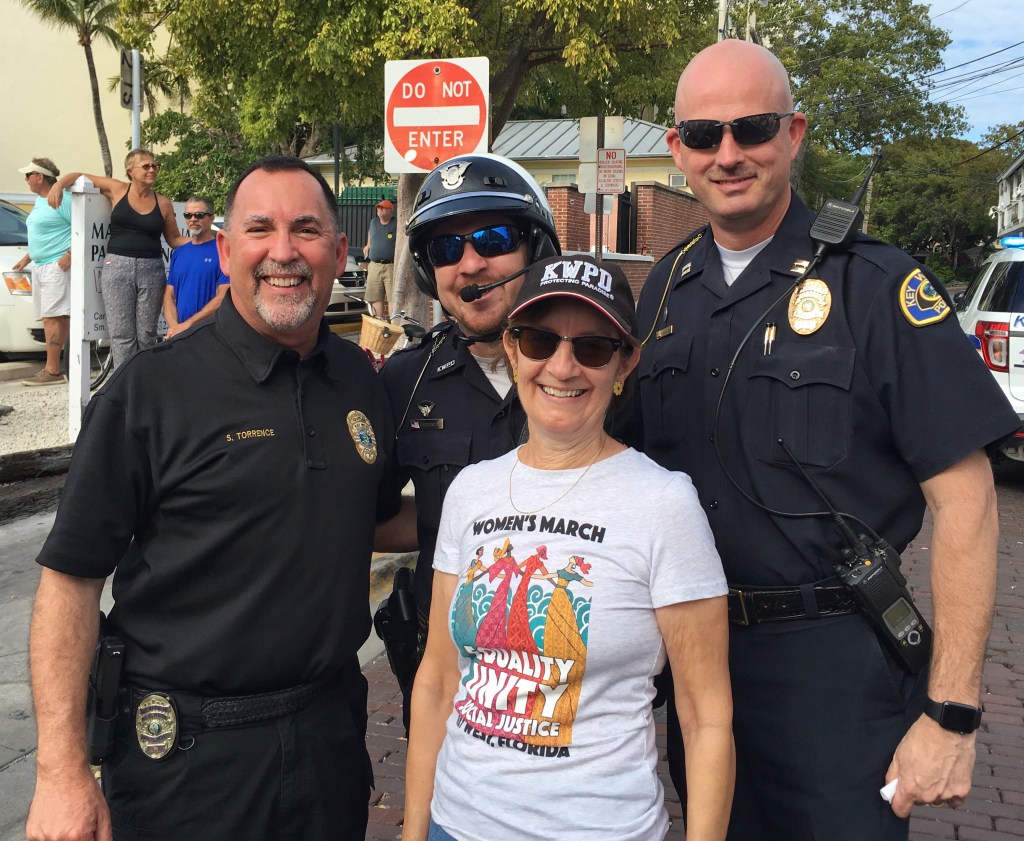
But A Poisonous Palate, the newest book in the Key West series, took a different turn: much of the action takes place up the Keys in northern parts of Monroe County rather than Key West proper. This part of the county is patrolled by the Sheriff’s Department, not the Key West Police Department. That meant that Hayley Snow’s detective husband wouldn’t be involved in a case, nor would other familiar Key West police characters like Steve Torrence and Chief Sean Brandenburg.
Luckily, the Monroe County Sheriff’s Office offered their Citizens Police Academy last year, and I was able to enroll. Twelve of us citizens met for seven Thursday sessions of three hours each to learn about all the amazing things the sheriff’s deputies do. As I wrote the new book, the temptation was as always to cram in more of my newly acquired knowledge of police procedure than the story needed or could support. For example, one week the Monroe County crime scene investigator showed us his lab and had us suit up in Tyvek to learn fingerprinting, foot printing, and identification of bodily fluids. But would my food critic character Hayley Snow have an opportunity to learn all of this? Probably not. She sure shouldn’t get involved in traffic stops after a felony crime has been committed or participate with a SWAT team searching an abandoned building for criminals. I did use bits and pieces in A Poisonous Palate, and definitely discovered new characters. (Sergeant Tony Lopez was our cheerleader when we practiced shoot/don’t shoot scenarios, and he graciously agreed to have his name used for a fictional deputy.)

Much to John’s relief, I learned—again—that even if I was 50 years younger, police work would not be the profession for me. I’m terrified of driving too fast—even one video of a chase from a cruiser’s webcam gave me nightmares. Swat team work would not be for me either. Too old, too short, too nervous.
But unlike our son Andrew, I don’t see myself growing out of my fascination with police work—it seems to be a side effect of writing crime fiction.
Readers: Do you notice the details of police procedure when you read?
About A Poisonous Palate
Key West food critic Hayley Snow is working on this week’s articles for Key Zest magazine when an intriguing email hits her inbox, titled “Hemingway’s toxic love and an old story.” Catherine Davitt tells Hayley that she has returned to the Keys to research a book, but she also wants to investigate the disappearance of an old friend back in the late 1970s. The two young women were part of a group of lost souls camping in the mangroves on Big Pine Key, until Catherine’s friend Veronica disappeared, and the Sheriff’s Office cleaned out the camp.
Ever-curious Hayley agrees to help her, and they travel up the islands to Big Pine Key to talk to some other islanders who were around in the 70s. They stop at an old motel to visit a man who was on the outer edges of this commune. Instead of answers, they find him murdered. It’s hard not to imagine a connection. Then Catherine disappears, leaving Hayley and Miss Gloria to unravel two possible murders, one old and one new, and track down a murderer who might very well have them in his or her sights.
When food critic Hayley Snow receives an intriguing email about a mysterious, decades-old disappearance, her curiosity is piqued. Writer Catherine Davitt has returned to the Keys to research a book about Hemingway’s wives, but she’s also on the hunt for the truth about her missing friend. Hayley quickly agrees to help investigate and they hit the road to see what clues they might find.
Back in the late 1970s, Catherine and her friend Veronica were part of a group of lost souls camping in the mangroves of Big Pine Key, until Veronica vanished, and the sheriff’s office cleared out the camp. Catherine and Hayley begin interviewing Big Pine Key residents who were around at the time of Veronica’s disappearance, but uncover more questions than answers.
Catherine and Hayley stop to speak with a motel owner who frequented the fringes of the commune, but they find him stabbed to death. Then Catherine also goes missing, and signs point to a connection between the old case and the new murder. It’s up to Hayley to unravel the knot of secrets and lies before time runs out.
Order the book wherever books are sold: https://www.penguinrandomhouse.com/books/729842/a-clue-in-the-crumbs-by-lucy-burdette/
https://facebook.com/LucyBurdette
www.instagram.com/LucyBurdette
https://www.bookbub.com/profile/lucy-burdette
About Lucy Burdette

Clinical psychologist Lucy Burdette aka Roberta Isleib is the author of 24 mysteries, including her August 6 release, A Poisonous Palate, and USA Today bestselling A Clue in the Crumbs (Crooked Lane Books), Both the twelfth book in her Key West series, A Dish to Die For and the tenth, The Key Lime Crime, won the Florida Book Award’s bronze medal for popular fiction. Her first women’s fiction title, The Ingredients of Happiness and her first thriller, Unsafe Haven, have been published by Severn House. Her cookbook, Lucy Burdette’s Kitchen, recipes and stories from the Key West food critic mysteries, was also released this month. Her books and stories have been short-listed for Agatha, Anthony, and Macavity awards. She’s a past president of Sisters in Crime, and currently president of the Friends of the Key West Library.

 The Wickeds
Hands on police-learning is the best! As is having an officer on speed dial to answer questions. Congratulations on the new book – I’ll be picking up my copy next week after I get home from vacation.
I notice police procedure when I read, but I think that’s because I’m a writer.
LikeLike
Thanks Edith–it’s harder to gloss over things when we know a lot!
LikeLike
Congratulations on the new book! I share your fascination! I’ve been to two Writers Police Academies, on two ride alongs — one in Virginia and one in Massachusetts, and attended one ten week Citizens Police Academy. I loved it all — except for the fast car part when we were racing across town with lights and sirens going 80 on roads that are 45 mph looking for a car thief. I looked forward to this book!
LikeLike
Oh gosh, that sounds terrifying Sherry!
LikeLike
Congratulations on your recent book release. I do notice police procedures in the books I read.
LikeLike
You read so much Dru, it would be hard not to notice!
LikeLike
Huge congratulations on the newest book in the series. Another best seller, for sure!
I attended the Citizens Police Academy on Cape Cod several years ago. We went to a local firing range to practice shooting a gun and I refused to do it. I told the policeman in charge that I wrote mysteries and wanted to observe and take notes about how the other classmates handled shooting a gun for the first time. An amazing eye opener for me!
LikeLike
Wow that’s so interesting Susan! We did practice shooting in a stressful situation with the Sheriff’s deputies (chalk guns of course), and all of us were so nervous!
LikeLike
Attending the Citizens Police Academy sounds like fun and informative – a fabulous combination!
When reading, I do find myself noticing the police procedures as well as many other details that show that the author did the research for accuracy to keep the story “real”. It really does tell in a story in how it flows and engages the reader. Honestly, I have read stories where you stop and shake your head knowing that couldn’t have possibly happened. No one is an expert on everything, but when you find something you know is represented incorrectly, it can affect continuing to read that particular author’s books knowing they didn’t do the research to keep it true to form. For me, if you don’t keep it accurate, then don’t write it into the story because someone is going to call you out on it – even in fiction.
2clowns at arkansas dot net
LikeLike
That’s a good point Kay, if you can’t write the details accurately, don’t write the scene!
LikeLike
Congratulations, Lucy! Your experience with the Sherriff’s Department sounds like a blast.
Unsurprisingly, since I write a police character, I definitely notice police procedure when I read. 🙂
LikeLike
Not surprising Liz! We did love the academy!
LikeLike
Congratulations on the new release. I was fortunate enough to read it on NetGalley and loved it!. While I do notice police procedure when reading, I’m not sure I’d recognize a misstep unless it was pretty egregious. Most of my understanding of their procedures come from other mysteries or television! Glad you had the opportunity to attend their training. Sounds like a great experience.
LikeLike
thanks so much! we learn a lot from TV, whether it’s right or wrong:)
LikeLike
I do notice police procedure in books and on TV. My husband is a retired police captain. Funny that one day when we were watching a parade in Key West we ran into a fellow officer’s son who we hadn’t seen since he was a toddler. He’s a Key West officer. Congratulations of your newest release. I’m looking forward to reading it!
LikeLike
Odette, I didn’t remember your police and KW connections! How did you even recognize someone you hadn’t seen since toddlerhood?
LikeLike
My knowledge of police procedures comes from the mysteries I’ve read. I’m sure some of what I think happens isn’t right, but I will often get a sense that something is way off while I’m reading. Who knows if I’m right or not in those cases.
LikeLike
I absolutely love your books. We used to go to the Keys and stay in Marathon for 13 consecutive years in the Spring. We loved it and so that is what made me read your books. But your characters and mysteries and the houseboat have kept me reading them. I pre-ordered the book, and it was delivered today. I can’t wait to read it. Thank you for your fantastic books.
LikeLike
thanks so much for reading and for your very kind comment!
LikeLike
And I forgot to mention that your police procedures are right on from what I have learned. That is so cool that they let you attend those events.
LikeLike