by Barb, in Maine but leaving for Key West a week from today! So much to do

I first met author Juliet Grames, the Editorial Director at Soho Press, where she curates the Soho Crime imprint (an imprint I have long admired), when we participated in a Sisters in Crime “Read Like a Writer” event. The book we discussed was The Westing Game by Ellen Raskin. Juliet, it turned out, was a long time fan, to the point where she asks her new hires at Soho Crime to read the book as a part of their orientation. I next saw Juliet at this year’s Maine Crime Wave, where she combined her experience as an author with her experience in the publishing industry to give a barn-burner of a speech that everyone found inspiring. Finally, this fall I saw her in Brunswick, Maine, at an event sponsored by Gulf of Maine Books in support of Juliet’s latest book, The Lost Boy of Santa Chionia. (I realize I sound like a stalker. Honestly, just a fan.) Plus, The Lost Boy of Santa Chionia takes place in Calabria, Italy, where longtime blog readers will recognize I’ve had my own adventures.)
The Lost Boy of Santa Chionia is a crime novel and an historical, both in our wheelhouse here at the Wickeds, so I wasn’t sure if I should label this post Genre Hopping. I decided the book is different enough from our usual fare but still something our regular readers would enjoy. I read it and loved it.
My interview with Juliet follows.

Barb: The Lost Boy of Chionia is set in 1960 in Calabria, the toe of the
Italian boot. What attracted you to this specific time and place?
Juliet: My grandmother was born in Calabria in 1920, and I am passionate about drawing attention to–and lending clarity to–southern Italian stories and history. As I was researching Calabrian ghost towns where my grandmother’s ancestors had come from, I encountered the story of Africo, an infamous ghost town that was very problematically forcibly abandoned in 1951. I knew I had the bones of a crime novel right there–the perfect spooky, marginalized, and magical setting against which I could present a puzzle mystery drawn from real stories of disappeared immigrant men, stories I had collected through interviews with members of the Italian diaspora.
1960 was the right year to set the drama not only because of this phenomenon of forced displacement in Italy (and the world) but also because it was the moment of great flux: when post-war conservative policy was battling against progressive and humanitarian movements; when the female half of the population was still struggling for some of the most basic human rights; and when the ancestors of Italy’s modern criminal syndicates were still hiding in the woodwork. A moment of great hope, of thwarted change, and explosive frustration–sound familiar?
Barb: The book’s main and only point of view character tells the story from a time far in the future from the events of the story. Why did you choose to tell the story from this perspective? I have to say, even though this was the structure, as I read the book, my heart was beating just as hard as it would have if the events were happening to the characters right in the moment.
Juliet: The truth there is that I needed my character, Francesca, to be capable of some anachronism. If I had written her point of view strictly as a 27-year-old in 1960, she wouldn’t have had the frame of reference to be enraged about some of the things I wanted her to be enraged about. Having her look back from many years later, though, let me comment on these topics with a little more seasoning. I confess I just don’t have the discipline to execute a true, pure historical novel–I have too many axes to grind. Plus, the distanced narrator was an extra tool for letting me control which information I was going to withhold, or distract with.
Barb: (That strikes me a very clever, though I didn’t think of it when I read the book. Nothing takes me out of historicals faster than characters with unbelievably modern sensibilities. Or the opposite, modern authors with cliched views of attitudes in the past.)
At the heart of the book there is a twisty mystery. Much twistier, I must say, than it appeared to me to be at the beginning. As an editor of crime novels for two decades, did you come to this project thinking about things that must be in a good crime novel or must never be?
Juliet: I did absolutely feel that the stakes were very high here in terms of the composition of the crime plot–if I didn’t pull off a truly puzzling and tricky mystery I would lose all my credibility as a crime fiction editor. But I really wanted to give it the old college try–the book is as much of an homage to this genre I love so much as it is a contribution to it. I did indeed come in with a long list of which rules I had to follow and which I had to lovingly break at all costs.
Barb: At the beginning of the book the narrator repeats a saying of her father’s. “Some people never grow up…Some people grow old still pointing their fingers, or waiting for justice to bring down its hammer. But finding a culpable party doesn’t fix a problem. A grown-up is someone who knows when to take action, and who knows how to manage consequences.” I can’t ask how this plays out in the book, because I don’t think you can answer without spoilers. So I’ll ask, what does this aphorism mean to you? And, as I think about it, might we all improve our crime fiction if we paid attention to those last two sentences?
Juliet: The book, for me, is about the struggle to be a good person, and to make good, ethical choices, when the shape of society itself is fundamentally amoral, when obstacles are overwhelming. I hope that the takeaway from the book is an inspiration to readers to keep igniting their compassion: not to get burnt out by injustice, which is rampant in our world, or to lose stamina when the world doesn’t fix our problems for us. But you’ve cut right to the heart of things, Barbara. There is very much an intended second reading there that I hope unlocks how the reader wants to think about the story.
Barb: What are you working on now?
Juliet: A mystery set in the Italian Alps, where a carabiniere (military police) officer is investigating World War One remains that have emerged from the melting glacier–including a mysterious violin of troubling provenance.
Readers: Juliet was inspired to write this book by her grandmother. Do you have a family story/member that would might inspire a work of fiction? Tell us a little about it.
About Juliet Grames
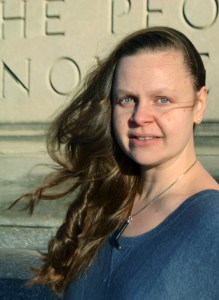
Juliet Grames is the national and international bestselling author of The Seven or Eight Deaths of Stella Fortuna and The Lost Boy of Santa Chionia. Her debut novel was shortlisted for the New England Book Award and the Connecticut Book Award, and received the Cetraro Prize for Southern Italian literature. It has been translated into nine languages. Her essays and short fiction have appeared in Best American Mystery & Suspense, Real Simple, Parade, Ellery Queen Mystery Magazine, and the Boston Globe, among other venues. She is Editorial Director at Soho Press, where she curates the Soho Crime imprint. She is the recipient of the Mystery Writers of America Ellery Queen Award. She lives in Rhode Island.
About The Lost Boy of Santa Chionia
One unidentified skeleton. Three missing men. A village full of secrets. The best-selling author of The Seven or Eight Deaths of Stella Fortuna brings us a sparkling—by turns funny and moving—novel about a young American woman turned amateur detective in a small village in Southern Italy (“Terrific” –Boston Globe).
Calabria, 1960. Francesca Loftfield, a twenty-seven-year-old, starry-eyed American, arrives in the isolated mountain village of Santa Chionia tasked with opening a nursery school. There is no road, no doctor, no running water or electricity. And thanks to a recent flood that swept away the post office, there’s no mail, either.
Most troubling, though, is the human skeleton that surfaced after the flood waters receded. Who is it? And why don’t the police come and investigate? When the local priest’s housekeeper begs Francesca to help determine if the remains are those of her long-missing son, Francesca begins to ask a lot of inconvenient questions. As an outsider, she might be the only person who can uncover the truth. Or she might be getting in over her head. As she attempts to juggle a nosy landlady, a suspiciously dashing shepherd, and a network of local families bound together by a code of silence, Francesca finds herself forced to choose between the charitable mission that brought her to Santa Chionia, and her future happiness, between truth and survival.
Set in the wild heart of Calabria, a land of sheer cliff faces, ancient tradition, dazzling sunlight—and one of the world’s most ruthless criminal syndicates—The Lost Boy of Santa Chionia is a suspenseful puzzle mystery, a captivating romance, and an affecting portrait of a young woman in search of a meaningful life.

 The Wickeds
Welcome, Juliet! I don’t know how I haven’t read your books yet, but I’m going to correct that shortly. As some of our regulars know, I was inspired by both my grandmothers’ personalities and skill sets to give them an alternate reality as lady PIs in the 1920s. . Dot and Ruth have appeared in a number of short stories in Alfred Hitchcock Mystery magazine and elsewhere, and I have one book out with Dot working with Amelia Earhart to solve crimes in 1926 Boston. I love riding historical fiction!
LikeLike
Edith, I think you will love Juliet’s books.
LikeLike
And I love a book inspired by a good grandmother story!! I’m embarking on my third novel now and haven’t run out of them yet 🙂 Your Dot and Ruth stories sound fascinating!
LikeLike
Thanks! (I was dictating my first comment – perhaps obviously, I meant writing, not riding…)
LikeLike
First off, thank you for introducing me to Juliet Grames. I’m not following on Facebook and can’t wait to explore her books.
For me, I think it might be my grandfather on my dad’s side. His past is a complete mystery. He immigrated to the United States as a young man (ages on documents differ) from a place in Austria/Hungary area that doesn’t exist now as an independent country. When he crossed the waters, he left everyone and everything from his past behind him. He refused to talk about it. Through the years and many researches that have been as many theories as to where and why, but no true answers. One was that he was running from the communist. I do know that he was extremely proud of his sons when they joined the military wanting to show them off when they came home on leave. He never did really learn English and as a child I remember he was extremely hard to understand. The imagination could have many types of mysteries taking place and historical facts revealed in a story about his life and times. It would have to be a mostly fiction story because of so few actual facts. That might make it easier having no boundaries to keep. 🙂
2clowns at arkansas dot net
LikeLike
How interesting. I think it’s a common marker for that whole generation, “Left it behind and didn’t want to talk about it.” Fiction is freeing for these people we didn’t know well. I was saying that about my characters Fee and Vee Snugg and Gus just Tuesday at a book event.
LikeLike
You’ve got a heck of a recipe right there.
LikeLike
Welcome to the blog! Such a great interview — thanks Barb and Juliet!
LikeLike
You are so welcome.
LikeLike
Congratulations, Juliet! The story sounds intriguing. As a historical author, I applaud your choice to make the narrator “looking back” because yes, it’s very unsettling as a reader to have a historical character have too-modern sensibilities.
My grandmother inspired the main character for my Homefront Mysteries series.
LikeLike
I’m not sure I knew that, Liz!
LikeLike
Congrats on the book! It sounds very good.
LikeLike
It is very good.
LikeLike
Wonderful interview. Thought provoking. I’ve dabbled with writing a historical fiction book set in 1880s West Texas where my ancestor, Svante Magnus Swenson, created four cattle ranches with the SMS brand. He’d landed in penniless in America from Sweden in 1836. Sold mercantile goods from a wagon, married into a plantation in the Galveston Area, turned that into an Austin store, fled to Mexico and then New York City during the Civil War, where he opened a bank, before returning to Texas to open ranches. He and his two sons get a cameo in my Love in a Time of Hate set in 1870s New Orleans, opening the door for a follow up.
LikeLike
What an interesting background for fiction. I’m so glad you enjoyed the interviews.
LikeLike
Hello, Barb and Juliet. I thoroughly enjoyed this interview, which made me want to read The Lost Boy of Santa Chionia. I am fascinated by books that show people struggling to be “a good person” in situations where it isn’t necessarily clear what “good” is and goodness isn’t rewarded anyway. In my mysteries, I try to create moral challenges for my characters–I suppose other readers like to read about these kinds of dilemmas as much as I do.
I haven’t thought about putting any of my grandparents or great-grandparents in a novel; I wish I had more information about them.
LikeLike
I am so glad you enjoyed the interview, Kim. I agree that books about struggling to be a good person, especially in ambiguous or unknown circumstances can be fascintating.
LikeLike
The book sounds so incredible, and I loved the quote you included! As for your question, I do have some short stories based on family members, but the similarities are only very slight. I more so become inspired by their sayings and stories, rather than their characters.
LikeLike